

Sorry, but the short answer is yes, and we’ll come to how and why in a minute.
It’s the question I get asked most often: ‘Does my phone listen in on me?’ ‘Is it eavesdropping on our private conversations?’

We’ve all been there. You are chatting away with friends about something totally random. Someone mentions bouncy castles. You have a laugh and proceed to bore everyone rigid by telling them how a new electric car can inflate a bouncy castle with its battery— yes, I filmed this for a TV show, yes, I really am boring enough to mention this in conversation. The next thing that happens is your social media is flooded with ads for bouncy castles. How can this be? You didn’t search for it on your phone? You didn’t watch any videos or follow accounts talking about bouncy castles. How can advertisers know you were talking about bouncy castles? Your phone must have been listening to your private conversation. It is the only explanation isn’t it?
All the big tech companies like Google, Apple, TikTok and Meta insist they don’t target us with ads by listening in on our conversations. Unfortunately for them, over half of UK smartphone users don’t believe them.
To help us get to what is really going on, I want you to think about those nearest and dearest to you in your life. Out of them, who do you think knows you best? Is it your parent? Your best friend? Your partner? Your soulmate? OK, now whoever you ended up with, do they know you better than your phone? Before you answer that, here’s what your phone knows about you. It keeps track of where you go and who you go there with. It has a record of every question you’ve asked online, including the ones you deleted. A list of all communications, who you spoke to, when and for how long. If there’s wearable connected to it, it has extensive health data about you. Your phone knows what you like doing in your spare time— is it scrolling or jogging? All these data are used to create a ‘digital profile’ containing: your income, your politics, your desires — things you never told it and might not have told anyone. Still think it’s your soulmate? Really?

Your ‘digital profile’ is at the centre of the online economy. This is what makes the whole thing work. It’s why social media platforms are free. This is why many useful apps are free — because you are the product. Every time you land on a web page, there is an auction between advertisers to see who gets to show you their ads. It takes milliseconds and it is all based on that ‘digital profile’ that follows you everywhere as you are tracked around the internet. Why are you tracked? Because you agree to it when you land on a page. When you accept the cookies, you also accept a whole load of things including trackers.
Have a look at one of the most visited news websites. The Daily Mail online. Here’s what they want you to agree to when accepting the cookies.
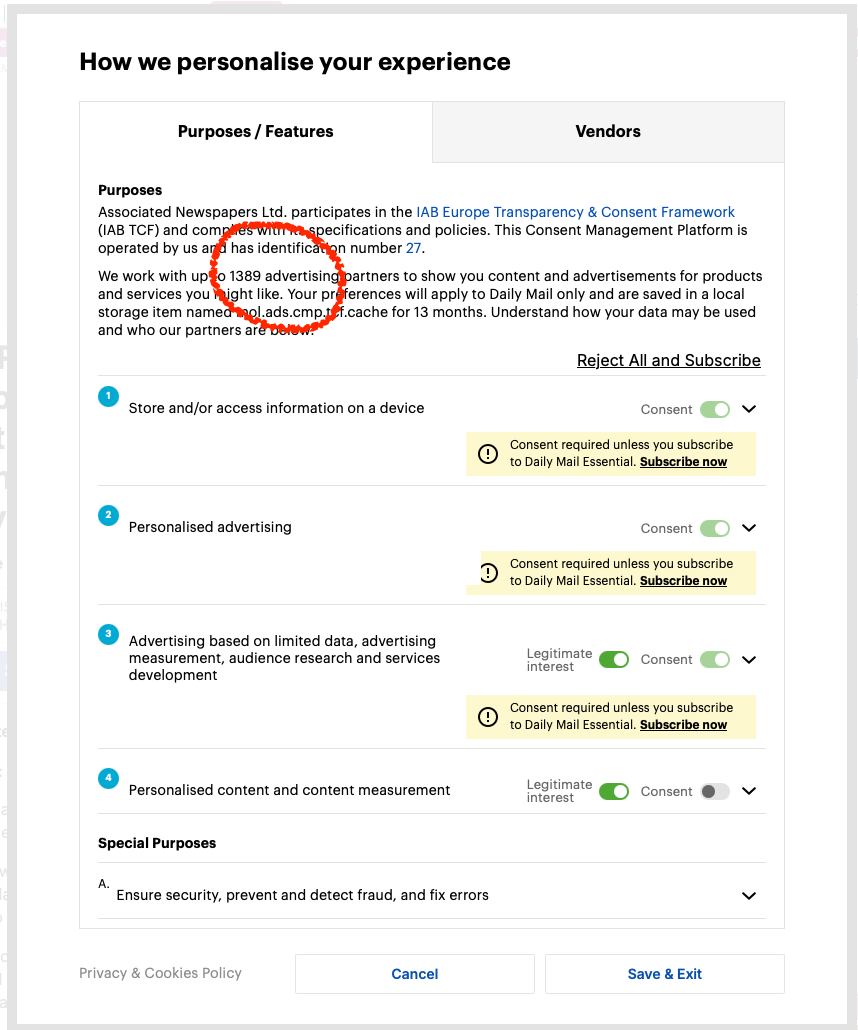
Yep, they work with 1389 partners who may be interested in your data.
So, how did we end up in a place where our phones know more about us than those we love and trust? How can apps connected to companies most of us have never heard of have access to so much of our private data. The answer is we agreed to it. Every time you download an app you agree to its terms and conditions. That may include giving it access to your location, your camera, your contacts and your microphone. Some apps may genuinely need access to your location, Google Maps for example would be pretty useless without it but as this data is gold dust to advertisers, many apps really do take the piss.
An early case of overreach was The Weather Channel app which was accused of misleading their 49 million users into thinking their location data would be used only to provide them with ‘personalised local weather data, alerts and forecasts’. A privacy lawsuit brought against them claimed that:
‘Once granted permission by the user, the company allegedly tracks, collects and maintains records of their precise locations and movements in real time, regardless of whether the app is open.’
It went on to claim the data collected was sold into ‘the $21 billion location targeting industry, where information about where and when consumers live, work, play and dine is of great value to marketers and advertisers.’ The Weather Channel settled the case and agreed to change the way users were informed.
The problem is everything you buy now comes with an app. An air-fryer now has an app and that app that wants your address, your post code and your date of birth. Why? Because on top of the money you’ve spent on the kit they also want to make money from your data.
There are of course people who don’t mind their data being used for profit. In their minds they are getting a service in return and targeted advertising means they see things they are genuinely interested in. However, there are other more sinister and worrying side effects than just ads following you around the internet. Times journalist Matilda Davies requested all her data from Facebook. She was astounded at what they knew about her.
“March 14, 2022, was an ordinary day. I snoozed my alarm at 7.15am and then again at 7.30am. I checked on a prescription at 10.25am, scanned my bank balance at 2.40pm and bought a birthday card for my father at 4.05pm.
I didn’t record these mundane actions, but Facebook did.”
They even tracked her visiting NHS websites looking for information on bowel cancer and they knew she was searching for mental health councillors. It is important to remember that it’s not just what we like to read and watch on TV or buy online that is sold to data brokers. Sensitive issues like victims of rape, men who suffer from premature ejaculation, patients who suffer from HIV, people who have lost a child, all this is fair game in the data market. If they know what makes you vulnerable or scared or angry, they know what to sell you.
I don’t know about you but I think that’s a very high price to pay for being able to watch kitten videos on Facebook.
‘That’s all very well but how do they know I was talking about bouncy castles with my mates?’ I hear you cry. ‘Is my phone eavesdropping? Because if it is I’m screwed!’ The bottom line is if you have activated the ‘Hey Siri’ or ‘Hey Google’ function on your phone then it is absolutely listening in.

It is waiting to hear the command to launch the digital assistant, so it has to listen in. Famously, an Apple whistleblower claimed that Apple contractors where able to hear ‘drug deals, medical details and people having sex’. Apple claimed that those recordings were used to help Siri dictation and understand users better, recognising what they say to prevent accidental activations. Similar cases have taken place with Amazon Alexa and Google Assistant. We have been assured again and again that big tech companies are not listening to us for advertising. The truth is we have no way of being absolutely sure but to this day there has not been any proof that they do.

So what’s really going on? The closest we can get to is something called ‘proximity advertising’. It’s the assumption that you will have similar interests with people you chose to associate with. Remember our phones are always very busy doing things without our knowledge. Let’s go back to the meeting with your friends where the subject of bouncy castles came up. Say you are in a pub, your phone will ping the WiFi network even if you don’t connect to it. That becomes location data apps and trackers can use. Couple that with your friends’ phones doing the same. Now one meeting is not enough but say you and your friends meet regularly. This now becomes an association. Advertisers can use that. One of the group has been obsessing about bouncy castles, they’ve been googling them and looking to rent one. Your ‘digital profile’ may include that you have children based on your purchases. Advertisers take a punt thinking you may have similar interests with your mates, result is you get to stare at bouncy castles whenever you go online until you finally buy one to make the ads go away.
So what can you do to minimise the amount of data you are unnecessarily sharing?
Never sign into anything using your social media accounts; you’re just handing them too much data.
Think if you really need an app for your fridge or your bloody air-fryer?
Always reject cookies if you can. Why agree to more trackers following you around?
Switch off the ‘Hey…’ voice activation for Siri or Google. Are you happy having live mics in your home and in your pocket at all times?
Instead of scrolling one evening. Go through your settings and check which apps have access to things they don’t need to on your phone. Does your banking app really need access to your microphone at all times? Does your toaster app need your location? Check which apps have access to camera, microphone, location, Bluetooth, etc.
Here’s how to do this on an iPhone and an Android:
Apple
Settings—Privacy and Security.
Android
Settings—Permission Manager
In an ideal world, data collection should not be the default. People should have to opt in to share their data. It’s a much more rational system. You wouldn’t need to waste time and go through the frustration of having to say no to cookies every time you visit a website. I know, it sounds like a pipe dream. It reminds me of years ago when I spoke at an internal event at Facebook’s headquarters in Covent Garden. I finished my talk with a suggestion that to better protect their users every new account should come fully locked down and the user should have the choice of setting who can see their posts. I got some very strange looks.
It is a little bit strange that most of the people in the U.K. don’t want things like I.D. cards because they are worried about government overreach. And yet, they’re very happy to share their most intimate data on social media or with apps that control their air fryers or toasters. It doesn’t seem to make sense. What really doesn’t make sense is that we’ve yet to grasp that our data, our names, our addresses, what we do, where we eat, where we travel, all that information is possibly the most valuable commodity on the planet and we’re just giving it away for free.